

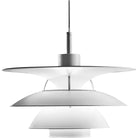
PH 6½-6 Pendant
- 110% Price Match
- Easy Returns
- Tariff-Free
Poul Henningsen designed the three-shade system during 1925/1926. The first lights using the system were designed for an exhibition in Paris. His work with Louis Poulsen continued until his death in 1967. Throughout his life, PH sought to create glare-free lighting; aiming to direct light where it was most needed, and creating soft shadows while using incandescent bulbs as a light source. The four-shade system was launched in 1931 to create a fixture that could be mounted high up and serve as an alternative to the commonly used chandeliers. The PH four-shade fixture was designed to increase the amount of light emitted horizontally to provide greater illumination of walls and shelves than was possible using standard three-shade lights. It was removed from the Louis Poulsen standard range in the 1940s, but was redesigned in 1979 by Danish architects, Sophus Frandsen and Ebbe Christensen, for the Charlottenborg exhibition building in Copenhagen (although in a larger size: PH 6½/6). To resolve the never ending glare problem, the two architects decided to add a small blue shade to the design. They also included a new surface with a more matte, white painted shade, to achieve a more even, comfortable light, ideal for museums and exhibition rooms or as general lighting in rooms with high ceilings. A smaller version, the 5/4½, was created for the Aarhus Concert Hall in 1984.
Dimensions
| Dimensions | 25.6'' W x 16.4'' H |
|---|---|
| Weight | 19.1 lbs. |
| Chain | 144" |
Product details
| Finish | White |
|---|---|
| Material | Shades: Spun aluminum. Struts: Rolled aluminum. |
| Collection | PH 6½-6 |
Electrical
| Bulbs | LED Integrated 96W 4420LM 90CRI, Dimmable 0-10V |
|---|---|
| CCT | 3000K |
You know you are getting the best Canadian landed price at Canada Light Shop. If you find the same product advertised for less by one of our Canadian competitors within 30 days of your purchase, we will gladly match the lower price + 10% of the difference. Click here for more information.
Description
Poul Henningsen designed the three-shade system during 1925/1926. The first lights using the system were designed for an exhibition in Paris. His work with Louis Poulsen continued until his death in 1967. Throughout his life, PH sought to create glare-free lighting; aiming to direct light where it was most needed, and creating soft shadows while using incandescent bulbs as a light source. The four-shade system was launched in 1931 to create a fixture that could be mounted high up and serve as an alternative to the commonly used chandeliers. The PH four-shade fixture was designed to increase the amount of light emitted horizontally to provide greater illumination of walls and shelves than was possible using standard three-shade lights. It was removed from the Louis Poulsen standard range in the 1940s, but was redesigned in 1979 by Danish architects, Sophus Frandsen and Ebbe Christensen, for the Charlottenborg exhibition building in Copenhagen (although in a larger size: PH 6½/6). To resolve the never ending glare problem, the two architects decided to add a small blue shade to the design. They also included a new surface with a more matte, white painted shade, to achieve a more even, comfortable light, ideal for museums and exhibition rooms or as general lighting in rooms with high ceilings. A smaller version, the 5/4½, was created for the Aarhus Concert Hall in 1984.
Specifications
Dimensions
| Dimensions | 25.6'' W x 16.4'' H |
|---|---|
| Weight | 19.1 lbs. |
| Chain | 144" |
Product details
| Finish | White |
|---|---|
| Material | Shades: Spun aluminum. Struts: Rolled aluminum. |
| Collection | PH 6½-6 |
Electrical
| Bulbs | LED Integrated 96W 4420LM 90CRI, Dimmable 0-10V |
|---|---|
| CCT | 3000K |
Downloads
110% Price Match
You know you are getting the best Canadian landed price at Canada Light Shop. If you find the same product advertised for less by one of our Canadian competitors within 30 days of your purchase, we will gladly match the lower price + 10% of the difference. Click here for more information.

Louis Poulsen
Copenhagen, Denmark
The Danish company keeps its forms simple and purposeful. Shades, proportions and finishes are chosen to direct light precisely, which gives the collection its calm, timeless look. Alongside the classics, Louis Poulsen continues to work with new designers, adding pendants, wall lights, table and floor lamps that follow the same principles. Hung low over a dining table, a Louis Poulsen pendant gives an even, comfortable light that makes a room feel easy to spend time in.